The Thing About the Trees
Had he been the trees, he could not have better predicted their nature. Their trunks felt as he imagined them to feel. His hands both roughed up the sides, probing them.
The wind was much less a bastard in their midst, and so he decided to love them. He looked up from beneath and felt different about them than he’d felt in the field. They were no mere waypoint; they were a home. And the spreading, tangling branches above seemed to hug him.
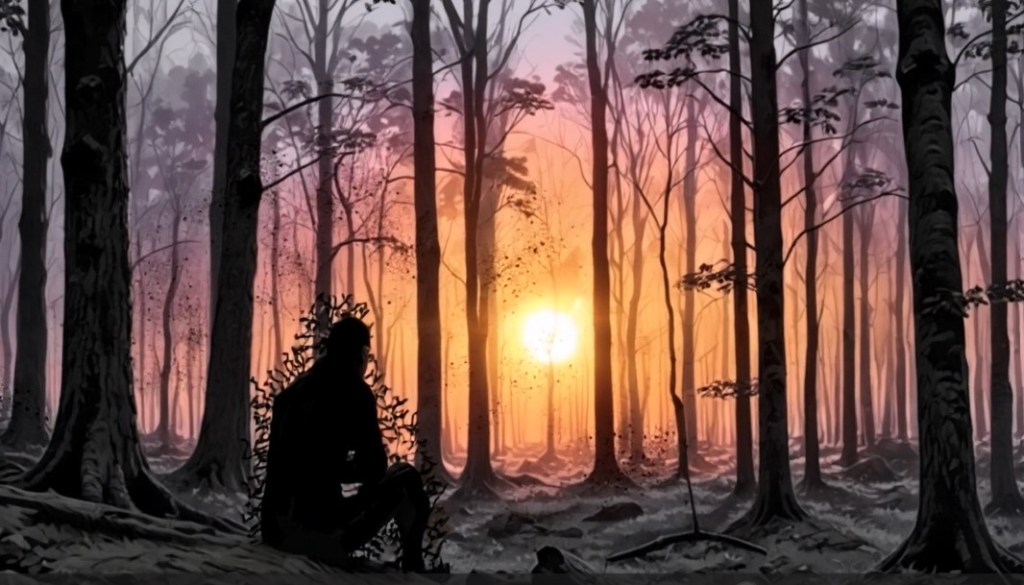
The grass beneath his toes was less a carpet and more a patchy expanse of dusty, grey dirt interspersed with yards of thin, crabby weeds. He sat under the trees. The wind did not disappear but acquired the quality of nuisance as opposed to threat.
Against the hard bark, as small, twirling towers of dust were picked up and sent off to their demise before him, he considered his situation. He now knew of cold and motion and the hard bark of the trees — not much else.
His mind seemed overrun with thought — again, the shapeless variety, vaporous and looming.
Someday, at some time, all these things will be known. He told himself this inside his skull. He began to suspect this was just the beginning of all things.
#
The trees have conned me. (Again, inside his skull.)
Much later, he sat still beneath their branches in an almost dreamlike state. Knowing his skin to be thin but not having gained knowledge of the concept of insulation, he sat still in the cold, unaware of much.
The sky’s blue ice had transitioned to a bloodless grey, and the bright orange flame sat, sassy and proud, in the crook of two hilltops, far away from him.
He could barely bring himself to look over his shoulder at the spectacle. He found himself overexcited by thoughts of the trees and his measurement of their character . . . for they had lied to him.
He noticed things during those cold hours.
He noticed they had within themselves a silent order.
This caused him to wonder about the order of life for his kind and whether such a thing as “his kind” had ever drawn breath. He’d not seen any for the entirety of his existence. But there inside appeared to be shreds of them. That is to say, parts of a whole shining within him, indicating his incompleteness.
A measuring of himself was necessary. He considered his legs down to the toes on his feet. These things, little buttons, bony protuberances from the front of his walkers, looked strange to him. He wiggled them. The tendons beneath the skin shifted, and he caught sight of the mechanism at play — sensible and stalwart — having hauled him from the field to the trees.
He leaned back, surveyed his hand and arm. He ran his thumb up and down its length, feeling the bone underneath. As he sensed the structure of himself, he looked up at the tree. He felt with them a kinship upon the discovery that he, too, had scaffolding, an engineered structure with which all his motions would consult. He understood himself to be alive, and the trees above him, all around him, were also; their skin rough and their hair falling now in confederacy with the cold wind.
He didn’t notice the temperature drop as the orange day slipped lower into the crevice of the hilltops. He didn’t notice as his breath began to hang in the air alongside him, crowding him in a loose cloud.
And it was in this sideways light, described in words as the evening, that he saw the sapling. He, at once, saw the entirety of its potential as if he’d sensed its ending before its birth and saw alongside it the inevitable tragedy it represented. Born into the hardscrabble dust and darkness, cursed from that birth onward to grow — such as it would — among the shadows.
He looked at the giant, rough tree above him, interwoven with the others, lucky to have come first, before the young ones — lucky to have seen the sun at birth and be granted an avenue to flourish in its eyes. Now, clawing, neighbor to neighbor, they selfishly shut out the light.
The ground around him, with its thinned grass, accommodated only the toughest of weeds — prickly, angry-looking things. Then, the large plates of dust kicked up as the wind snuck in from time to time.
And then, the little guy . . .
The sapling was stooped, heavy with the weight of its onrushing end, desperate, aiming for illuminance — injured, as it were, by darkness. He believed it had found what it could and would find no more. All the others like it, sproutless acorns, never drew a single breath. The branches above it, broad and strong — stronger than it would ever be — spread wide and mingled, stealing the radiance. The poor little thing would not last, and the trees above it provided the darkness in which it should drown. They were monsters, strong and tall, both birthing it and choking it to death. He wondered why they would do such but accepted it as the way of things.
The child takes shallow root and catches a glimpse of light. But then is brought down, all in the unfeeling tide of the nature of the trees, the order of their lives.
He saw its end. It was in the shade, wilting and bent, and the vision reminded him of a past image — yes, it must be that — a memory! And in this memory, he saw one such as himself.
A bright light covered his vision. The other lay before him, not young, not a sapling or a tree at all. It was the same as he, lanky, cord-like, and bipedal. It, too, sought the light, and he found himself to be the terrible shadow. His outline, his shoulders cast over it, blotted out the sun. The traveler, the same as he, looked up, as did the sapling, yet as the trees were unmoved, so was he.
Lowly on the ground, the one before him was terrified at the thought of his withholding. This was obvious in its eyes: soft, trembling globes. It was in need.
Yet, he stood above it, soaking up the sun, and could not find it within himself to give a damn about it.
It could not move on the ground because he had broken its scaffolding and opened its bark. Its toes, tiny buttons on its movers, were useless—projections disturbed and gruesome by some earlier violent insult.
He believed the thing to have maneuvered itself into his wrath and could find no other explanation for its state or his possible responsibility. He stood in awe of its opened bark, the tender, glistening workings underneath, twitching in the exposed air — and the wetness of its terror, oozing off into the dirt around it.
It curled before him almost in a pose of prayer, for he wasn’t sure of the difference between begging and praying. His next actions were sudden and underpinned with feeling, undefined in his memory, yet underlying the motivations for the actions — more felt than understood, these things. Nonetheless, in the throes of them, he acted.
Inside the shadow of his self, he acted.
He refused to let the memory pass until he saw its end, and it was ugly. Then he stood above it. The soft globes were now covered with pink lids, and the bark was nearly gone. He did this.
Or did he? Did he ever do such a thing? How could he have?
He was only just born.
The big orange ball was a mere footnote of purple flame in the valley. It had made itself known to him, one last effort to rouse him from his ruminations, to call him to survival. When the heat of that purple flame touched his arm, he saw the trees again differently. He saw them as correct in all things and was hopeful that he, too, could claim as much. He noticed the wreckage and death at their beautiful feet.
He knew it to be correct.
There is no other way it could be.

 Weekend Insurgent
Leave a comment